
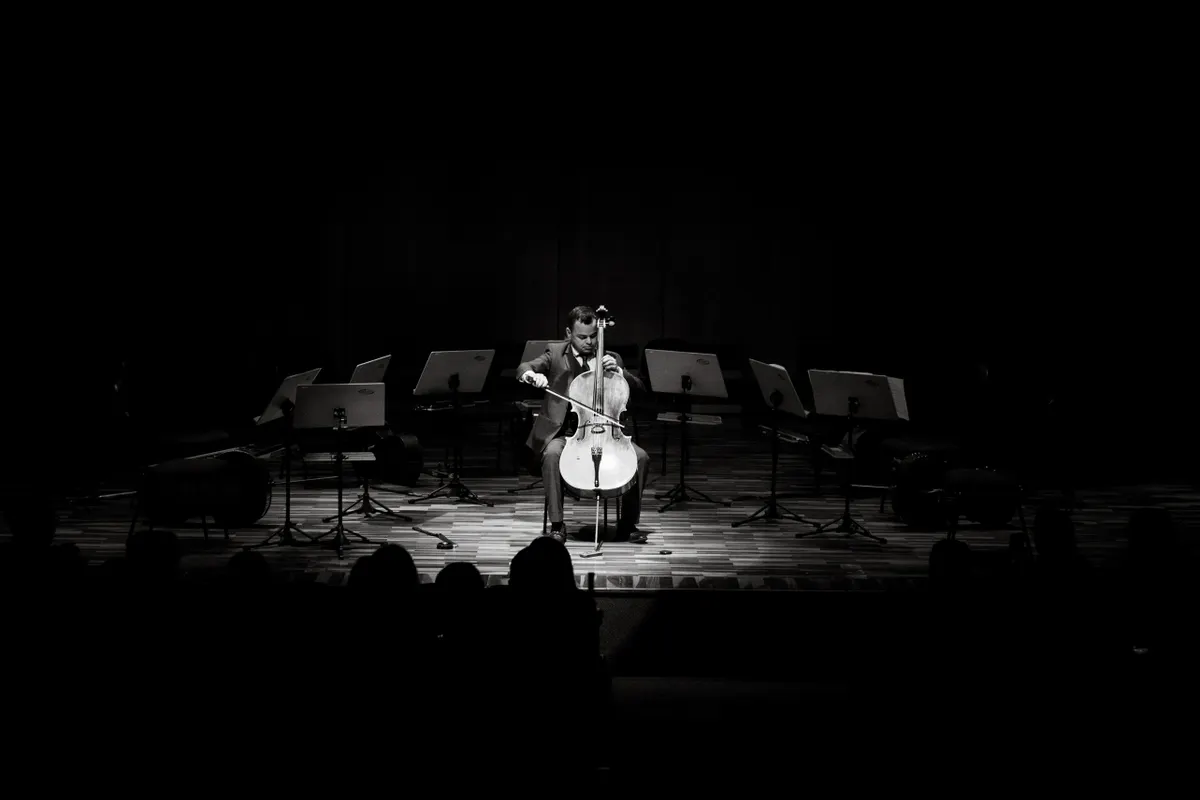
The opening gesture of Sheku Kanneh-Mason Hope in Shadow is already audible: a newly arranged version of John Williams’ ‘Theme from Schindler’s List’, recorded with conductor Edward Gardner and the London Philharmonic Orchestra, released as the album’s first single. Decca Classics has confirmed the full album will follow on 13 November 2026, as Colin’s Column reported.
A programme rooted in Jewish prayer and personal history
Hope in Shadow is Kanneh-Mason’s ninth studio album, and its programme has a coherent emotional logic. Works by Saint-Saëns, Bruch, Ravel, Bloch and Williams are placed alongside each other not for variety’s sake but because each one, in Kanneh-Mason’s own account, negotiates the distance between grief and consolation. ‘There is a darkness, a sombre and sorrowful quality that gives way to precious splashes of light,’ he said of the collection. The repertoire is partly shaped by Jewish liturgical tradition: Bruch’s Kol Nidrei draws on two themes associated with Yom Kippur; Ravel’s ‘Kaddish’ is built from the Jewish prayer of the same name; and Bloch’s Schelomo: Rhapsodie Hébraïque uses the cello as a voice for King Solomon, set against expansive orchestral forces.
That last pairing (Bloch and Williams) brings together two composers separated by more than half a century but connected by a shared subject. Williams’ theme was written for Steven Spielberg’s 1993 film, and its presence here is less a concession to popular taste than a recognition that the melody belongs in this liturgical and elegiac company. Kanneh-Mason describes Ravel’s ‘Kaddish’ as ‘the most intimate and singular voiced work on this album’, and one can hear why he would want it to anchor the programme: stripped back, almost uncomfortably direct, it makes the larger orchestral gestures elsewhere feel earned rather than merely grand.
The Saint-Saëns Cello Concerto No. 1 opens the more formally classical end of the record, alongside ‘The Swan’ from The Carnival of the Animals. Both carry a particular weight for Kanneh-Mason: he was drawn to the concerto as a child, and it was among the first he learned. Bloch’s ‘Prayer’, the opening movement of the three-part Jewish Life suite, has an equally long personal history. Written in 1924 for cellist Hans Kindler, it was a piece Kanneh-Mason first studied when he was around nine years old. There is something in that detail worth sitting with: the music that forms a performer’s identity is often learned before it is fully understood, and these works have had decades to settle into the body before the microphone was switched on.
Sheku Kanneh-Mason Hope in Shadow arrives at a milestone moment
The album reaches listeners at a point when Kanneh-Mason’s recorded output has accumulated considerable reach. According to Decca Classics, his recordings have now passed 500 million streams across digital platforms, a figure that would have seemed fanciful for a classical cellist when he signed with the label a decade ago. The anniversary of that signing, along with his BBC Young Musician win, both fall in this same year, giving the release an additional frame.
Gardner and the London Philharmonic Orchestra provide the orchestral platform throughout. Gardner’s experience with large-scale dramatic repertoire makes him a natural partner for music that depends so heavily on dynamic range: the shift from the chamber-like intimacy of Ravel’s ‘Kaddish’ to the full weight of the Schelomo requires an orchestra that can recalibrate its presence rather than simply turn the volume up or down.
The choice to lead with the Williams theme as a single is an astute one. It is the piece most listeners will recognise, and it places the album’s emotional argument in the clearest possible light before the deeper, less familiar repertoire makes its case. By 13 November, when Hope in Shadow appears in full, the programme’s internal connections, between Jewish prayer, childhood memory and a cellist’s particular relationship with sorrow, will have the space to be heard properly.
 Heart
Heart Haha
Haha Love
Love Wow
Wow Yay
Yay Sad
Sad Poop
Poop Angry
Angry
