
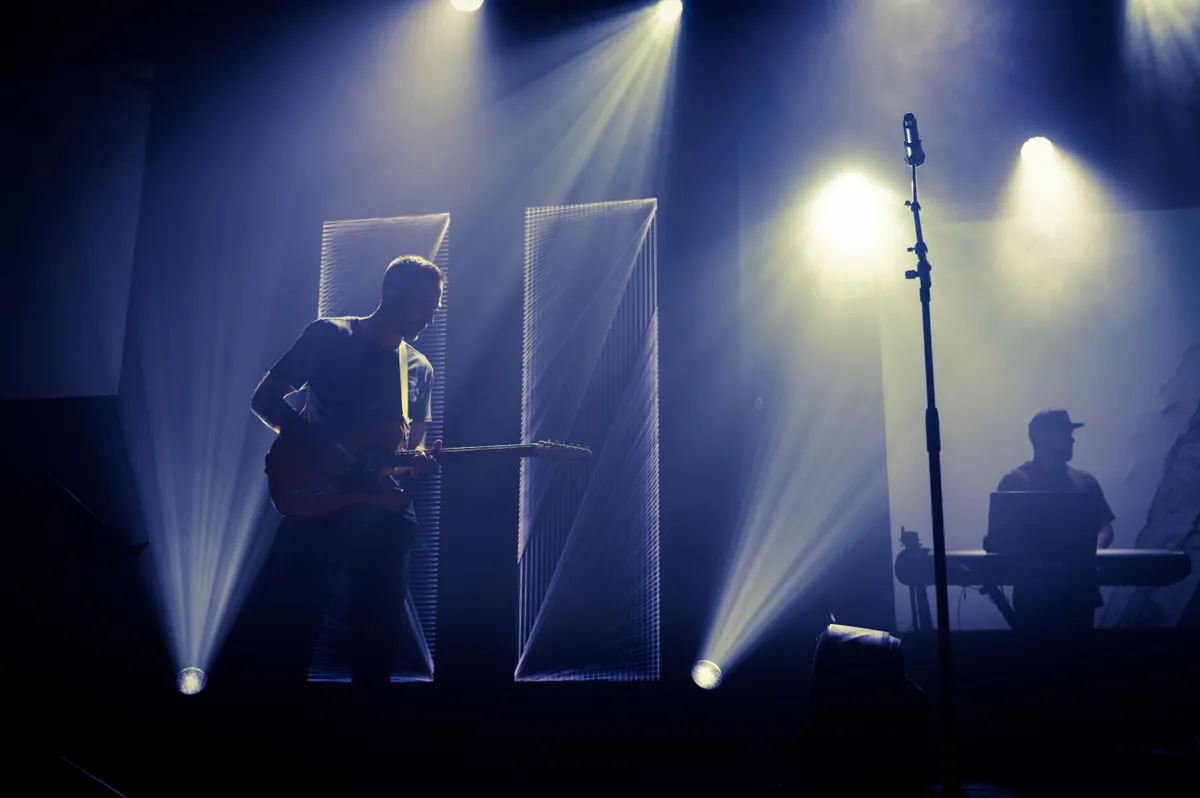
There is a word at the centre of this record that does a lot of work. Gorta, the Irish for hunger, gives the Madra Salach debut album both its title and its organising logic: the longing that passes between generations, the specific gravity of Irish inheritance, and the question of what it means to carry all of that into the 21st century. Due on 15 January 2027 via Island Records, it arrives with the Dublin six-piece already in the middle of a sold-out UK headline tour and a momentum that their early EPs barely hinted at.
What the Madra Salach Debut Album Sounds Like
The first single, ‘Ribbon Factory’, sets the parameters: Irish traditional forms bent toward something darker and more experimental, arrangements that move between quieter, intimate passages and full-band eruptions. All six members wrote the album collectively and recorded together as a complete group, a fact that matters when you hear how the dynamics shift. Loren Humphrey produced the sessions in New York; his recent credits include Westside Cowboy and Cameron Winter.
The full tracklist, confirmed by The Line of Best Fit, runs to ten songs: ‘Hunger’, ‘Ribbon Factory’, ‘Tunnel Tigers’, ‘Searrach’, ‘The Stolen Sheep’, ‘Bolg’, ‘She Talks to the Telly’, ‘Cranes’, ‘Circus Horse’ and ‘The Haunted Isle of Green’. That sequence of titles alone maps a particular Irish imagination: the mythological and the mundane pressed up against each other, the agricultural and the ghostly sitting in adjacent tracks. Oscar Torrans created the cover artwork, depicting a Blemmyes, a headless figure from ancient legend whose face sits in its chest. It is a choice that fits the album’s preoccupation with what is carried inside the body rather than announced from without.
Frontman and lyricist Paul Banks described the writing process in terms of grounding abstraction in the personal. ‘I usually write from personal experience,’ he said. ‘I try not to go too big-picture. I can tap into the emotions that way.’ As the material developed, however, its reach widened. ‘The ideas of longing and yearning, all the kinds of hunger, they slot into where we are as 21st century Irish people. The more I’ve thought and written about Irishness, the more I’ve seen how strange a history and a position and a culture we have.’
That framing places Gorta in a longer tradition of Irish music grappling with rupture and diaspora, from the plain-speech gravity of early Christy Moore records through to the post-punk urgency that bands of the last decade have used as a different kind of release valve. Madra Salach seem less interested in either extreme than in holding the tension between them.
Chart Pedigree and an Expanding Live Profile
The ground has been prepared carefully. Their debut EP, It’s a Hell of an Age, reached No. 3 on the Irish Albums Chart and the Top 10 of the UK Official Independent Albums Chart, figures that give Gorta a real commercial context to step into. Festival appearances have already taken in The Great Escape, End of the Road, Primavera, Latitude, Roskilde and Green Man.
The current sold-out UK headline run includes London’s Electric Ballroom and Manchester’s New Century Hall, with sold-out tours in Ireland and North America to follow. Ahead of the album’s release, the band are also set to appear at Rockaway Beach and Primavera, and, according to Still Listening, will support Fontaines D.C. at Slane Castle in June. A performance on Jools Holland is scheduled for 25 October.
Between the television slot, the Slane Castle date and a January release timed to land when the live year is still gathering pace, the architecture around Gorta is deliberately built. Whether the album matches that architecture is what January will settle.
 Heart
Heart Haha
Haha Love
Love Wow
Wow Yay
Yay Sad
Sad Poop
Poop Angry
Angry
