
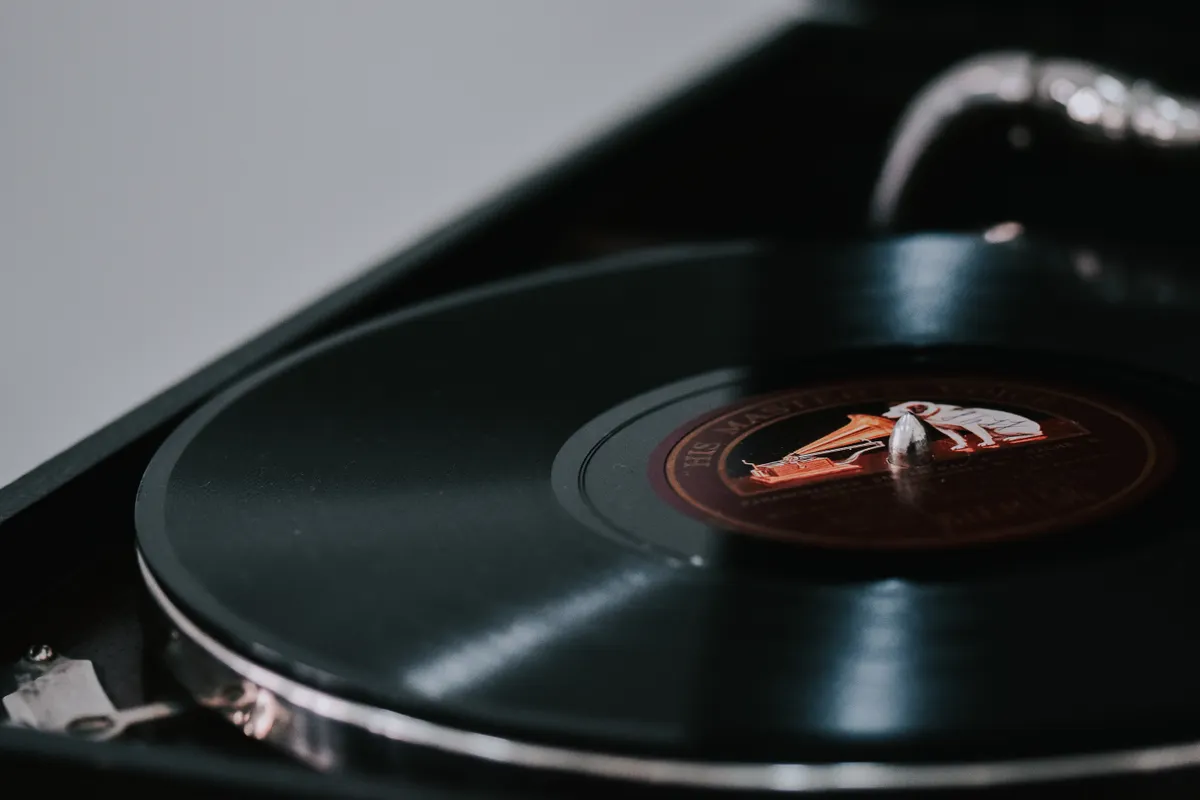
The idea behind liquid-filled vinyl records is precisely as strange and straightforward as it sounds: a playable LP with a sealed internal layer of liquid that moves as the record spins. It is the latest chapter in vinyl’s long tradition of treating the physical record as an object in its own right, something worth displaying as much as playing.
What Liquid-Filled Vinyl Records Actually Are
Vinyl has never been purely a delivery mechanism for audio. Coloured pressings, picture discs, splatter variants, elaborate box sets, the format has consistently invited designers and artists to treat the record itself as a canvas. Liquid-filled vinyl takes that impulse one step further, placing the visual element not on the surface but inside the object.
The construction works by bringing two pressings together, leaving an internal cavity that is then filled and sealed. The music remains pressed into the outer vinyl surfaces in the conventional way, so the stylus has no contact with the liquid at all. What the liquid does is move. As the record spins, different colours flow and merge, glitter or small objects can be suspended in the filling, and because the liquid settles differently in each copy, no two records look quite the same once they are in motion.
Recent editions have leaned into the concept with some care. The Shrek soundtrack has appeared filled with green “Swamp Juice”. Bob Marley’s Uprising has been paired with “Liquid Sunshine”. The Jaws soundtrack received a shark-infested treatment, and the Labyrinth soundtrack channelled the film’s Bog of Eternal Stench into its murky design. Among the artists whose catalogues have received filled editions are Rush, KISS, Audioslave, Sublime, and Bon Jovi.
Can You Actually Play a Liquid-Filled Record?
Yes, and this is where the format avoids the fate of becoming a novelty shelf piece. Because the liquid is sealed between the two vinyl layers, the stylus tracks the outer surface just as it would a standard pressing. There is no special playback speed required: if an album is cut at 33⅓ RPM, you play it at 33⅓ RPM. The liquid moving around inside places no unusual demands on the turntable.
The finished records are generally thicker than a conventional LP, a natural consequence of the layered construction. Most turntables accommodate this without difficulty, though some entry-level players may find the additional thickness a problem worth checking before purchase.
On the question of sound quality, the liquid makes no difference. The stylus reads the groove on the outer surface, not the interior. It is also worth being clear that “liquid-filled” says nothing about the mastering: whether an edition has been remastered, remixed, or sourced from a different transfer is a matter for each individual release, entirely separate from the manufacturing format.
The Cost and Care of a Specialist Format
The price premium over a standard pressing follows logically from the construction. Where a conventional record requires one pressing per copy, a liquid-filled edition requires two, one for each side. Those two halves then have to be combined, filled, sealed, and quality-controlled, with portions of that process completed by hand. Production runs tend to be considerably smaller than mass-market vinyl, which adds further to the cost per unit. More vinyl, more labour, a specialised manufacturing process: the higher price reflects each of those additional stages.
As for care, a liquid-filled record is manufactured to be handled and played, but it remains a more elaborate physical object than an ordinary LP. Owners are advised to follow the care instructions supplied with each specific release and to avoid extreme temperatures or unnecessary physical stress. The format does not require the reverence of a museum exhibit, but it is a collectible object that rewards sensible handling.
At its best, the format earns its existence when the filling becomes genuinely part of the release’s identity rather than a gimmick bolted on. “Liquid Sunshine” for Uprising, murky bog-water for Labyrinth, the obvious and entirely correct pairing of water imagery with Jaws: these are cases where the physical object and the music inside it are in genuine conversation. You can browse liquid-filled vinyl records currently available through uDiscover Music, which stocks editions across a range of artists and soundtracks. Universal Music, whose catalogue supplies many of the releases, maintains its own overview of the format through Universal Music. For collectors drawn to the Bob Marley editions in particular, the official Bob Marley site carries further details on available pressings.
For listeners who want an album on vinyl, a standard pressing remains the most direct route. Liquid-filled vinyl offers something else: the familiar ritual of the needle drop, combined with a record that becomes a different object the moment it starts to turn.
 Heart
Heart Haha
Haha Love
Love Wow
Wow Yay
Yay Sad
Sad Poop
Poop Angry
Angry
