
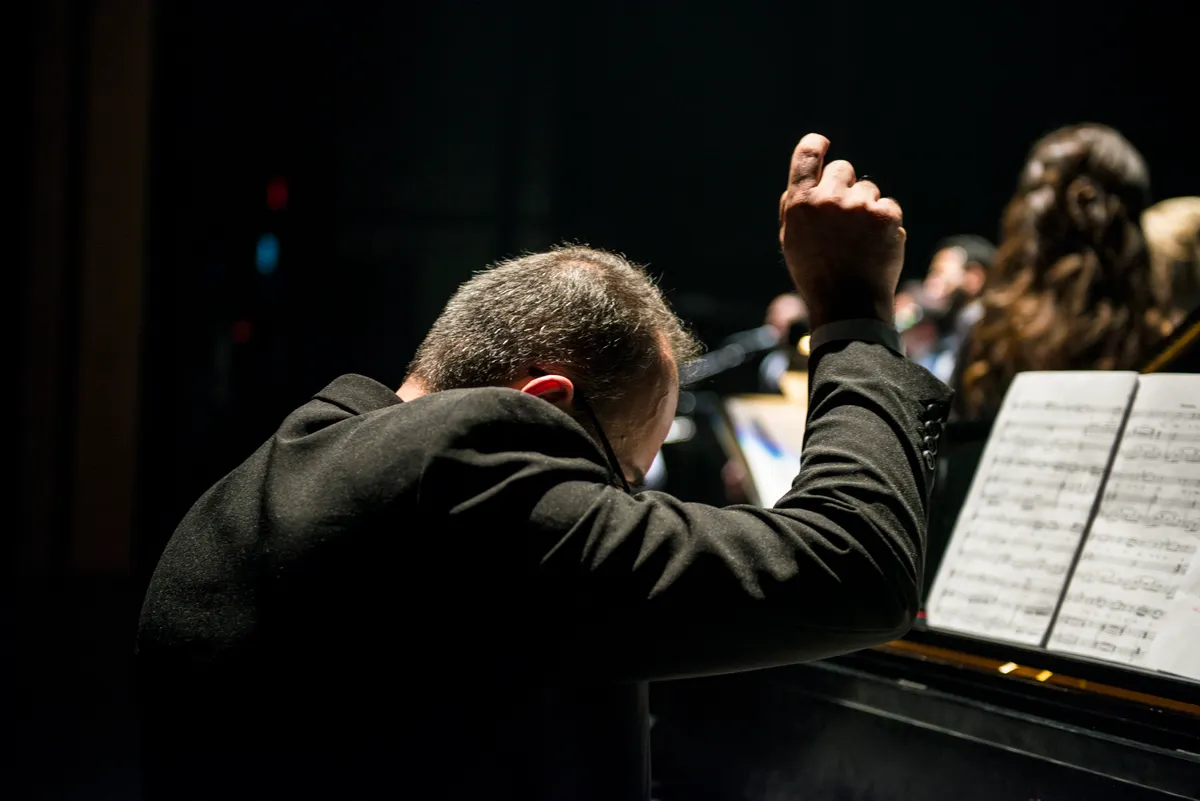
There is something quietly audacious about Yu-Peng Chen’s The Poem of Life, a 12-movement symphonic suite for piano and orchestra that arrives on Deutsche Grammophon on 25 September 2026. Where many composers working at the crossroads of Eastern and Western traditions content themselves with surface ornamentation, Chen structures an entire arc of human experience across the suite’s movements, from birth through childhood and adulthood to a final farewell.
Yu-Peng Chen’s Poem of Life: a suite shaped by memory and tradition
The project was recorded with the Shanghai Philharmonic Orchestra under conductor Zhang Liang, with Chen performing as piano soloist throughout. Pianist Yixuan Wei joins him on selected movements for two pianos, and the arrangements draw on traditional Chinese instruments including guzheng, erhu, pipa and sheng. Chinese opera singers Yi Li and Zhengzhong Zhou appear on the recording alongside guest performers Daniel Hope, Avi Avital and Philipp Schupelius. The gathering of voices and instruments from such different traditions is not incidental: it reflects the suite’s central ambition.
Chen has described the work as ‘a vessel’ for the emotions that shape human experience, with the music intended to prompt listeners to reflect on their own memories and personal histories. That framing carries a certain classical weight. Think of Mahler’s symphonies as investigations into mortality, or Britten drawing folk material into formal concert structures: Chen is working in a tradition of composers who use orchestral scale not for spectacle but for reckoning. Whether The Poem of Life earns that comparison fully is a question the listening will settle, but the ambition is plainly there.
The album is available digitally, on CD and on LP, and a performance video for ‘Love in First Bloom’ was released alongside it.
From Genshin Impact to the concert hall
Chen is best known for his music for the video game Genshin Impact, a body of work that has generated over 1.5 billion audio streams, according to Deutsche Grammophon. That figure deserves a moment’s reflection. It places him among the most-heard composers of his generation, operating largely outside the structures through which classical music traditionally builds its audience: concert halls, record shops, critical column inches.
His background is formally grounded: he studied at the Shanghai Conservatory of Music and has worked across film, television and gaming, collaborating with orchestras including the London Philharmonic and the Shanghai Symphony Orchestra. But the sheer scale of his reach through gaming has given him something most classical composers do not have: an audience that came to him young, on its own terms, without the gatekeeping of institutional classical culture.
The Poem of Life represents a deliberate move toward concert-focused orchestral work, following his previous project FANTASYLAND. The step is not a disavowal of his screen and gaming work. Rather, it suggests a composer interested in testing what his cross-cultural voice can do when freed from the specific dramatic requirements of a narrative medium.
The broader context matters here. Chen joined Deutsche Grammophon in August 2025, becoming the first Chinese composer to sign with the label. That distinction is worth holding alongside the music itself. Deutsche Grammophon carries a particular weight in the classical world: its roster and catalogue represent a specific idea of what concert music is and who makes it. A signing there is not merely a distribution arrangement; it is a statement about where a composer sits in the landscape.
The combination of Western orchestral writing with Chinese musical traditions that runs through The Poem of Life is an extension of compositional concerns Chen has pursued across his career. The guzheng’s plucked resonance against a full string section, the erhu’s bowed timbre threading through orchestral texture: these are not exotic additions dropped in for colour. They are structural elements, implying different melodic logics and different emotional registers.
Whether the suite sustains its twelve-movement span as a unified whole, or whether some movements feel more like discrete tone poems loosely gathered under a conceptual umbrella, will become clearer when the full work is heard in sequence on 25 September 2026.
 Heart
Heart Haha
Haha Love
Love Wow
Wow Yay
Yay Sad
Sad Poop
Poop Angry
Angry
