
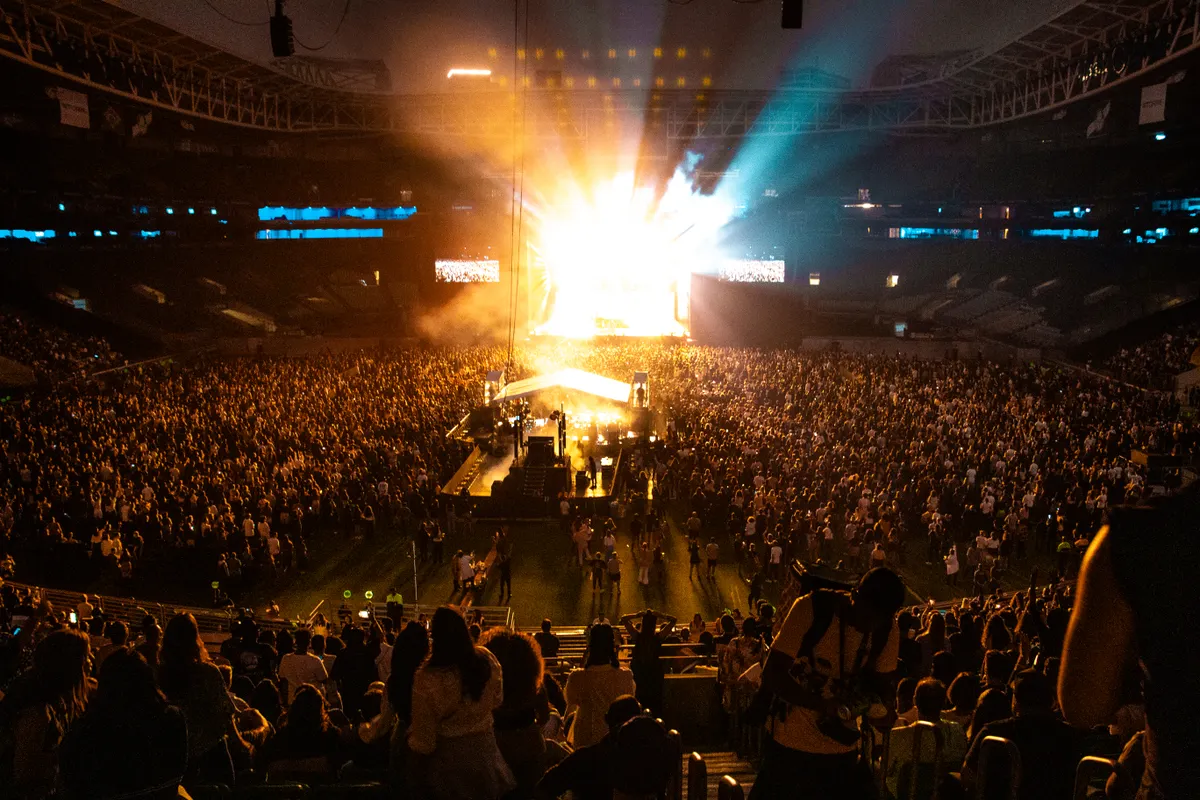
KISS Destroys Anaheim 76, the first official release of the band’s 20 August 1976 Anaheim Stadium concert, arrives on 21 August, finally giving a night that has circulated in bootleg form for decades its proper, archivally sourced document. According to Universal Music Canada, the show drew over 42,000 fans, the largest crowd KISS had played to at that point in their career, and the audio has been newly mixed by Eddie Kramer from the original multi-track tapes he recorded on the night itself.
A Night KISS Destroys Anaheim 76 Was Never Going to Let Go of Easily
There is something telling about a concert being remembered so vividly by everyone from the band’s guitar tech to a ten-year-old boy from Burbank. The 1976 Anaheim show, part of what was billed as the Spirit of ’76 Tour in support of the Destroyer album, occupies that particular place in rock mythology where spectacle and chemistry briefly fuse into something unrepeatable. Hearing bassist/singer Gene Simmons talk about it now, the wonder has not entirely left him.
‘We were just awestruck by the whole thing,’ Simmons tells SPIN. ‘We were staying at the Sunset Marquis on Sunset Boulevard, and you literally walked to the corner and right there was a billboard: “KISS: Anaheim Stadium.” We never had billboards!’ The roughly 30-mile drive south from West Hollywood to Anaheim carried the band towards a scale of reception they had not yet encountered. Guitar tech Barry Ackom, writing in the liner notes to Destroys Anaheim, recalls Gene and Paul, then 26 and 24 respectively, emerging from the vehicle and simply looking at each other. ‘Paul said, “Wow, I’ve never seen this many people!”‘
Photographer Brad Elterman, who was 19 and shooting backstage that day, frames it in the language of atmosphere rather than statistics. ‘It felt massive,’ he says. ‘There was definitely something in the air. I was at Sly and the Family Stone at the L.A. Coliseum, which had more bodies. But this was a cooler event.’ The crowd, he adds, ‘sounded like thunder.’
The Bill, the Wire-Walker and the Production That Changed the Game
The supporting card alone reads like an archivist’s fever dream. Bob Seger and the Silver Bullet Band, then just months from the release of Night Moves, opened alongside Montrose and Ted Nugent, the last of whom, after the sound failed during his set, scaled the PA system and eventually danced on top of it. Flo and Eddie, Mark Volman and Howard Kaylan of the Turtles, served as hosts and introduced KISS while wearing kabuki makeup applied by the band members themselves. Between sets, Steve ‘Unique’ McPeak walked a wire a quarter of a mile above the crowd, some of whom attempted to pelt him with rubbish mid-trick. Tickets were $10, promoter Fun Productions had saturated radio with ads, and band manager Bill Aucoin had trailed a next-level sound system in the press. Aucoin delivered.
The production that KISS brought in for the Destroyer cycle dwarfed anything on the previous tour. The flashing logo behind the band was larger, Simmons’s side of the stage was modelled after his demon persona, and Ace Frehley’s was themed around outer space. The 17-song set amounted to a live greatest-hits sweep: ‘Strutter,’ ‘God of Thunder,’ ‘Deuce,’ ‘Hotter Than Hell,’ ‘Cold Gin.’ Rather than the customary closer ‘Rock and Roll All Nite,’ the band ended with ‘Black Diamond,’ the Criss-sung number that drummer Peter Criss, now 80, claims as his all-time favourite KISS performance. ‘I remember going to the stage in golf carts, getting closer and hearing the roar of the crowd,’ Criss says in author Ken Sharp’s liner notes. ‘I’ll never forget that sound. My heart pounded like it was gonna go through my chest.’
Simmons himself took a tumble on the way down the fog-laden stage stairs in his seven-inch platform boots during the opening ‘Detroit Rock City,’ saving the bass from going out of tune even as he went down. ‘In the video, you can see me jump out of the fog and continue, like, “Oh, yeah, I always plan that.”‘
For ten-year-old Nick Cotrufo, there on his first concert with his friend Dave Fogerson and Fogerson’s father, the night meant a contact high, temporary hearing loss, and a memory he still measures his life against. ‘When I think about that day, it brings me back to a magical time in life,’ he says.
By the end of 1976, KISS had four albums simultaneously on the Billboard 200, and band members were earning around $85 a week at the time of Anaheim, most of their income being cycled back into the touring spectacle. The newly mixed audio, drawn from Kramer’s original multi-track recordings and released half a century after the event, is the first time any of that has been made officially available. ‘It’s just like a fairy tale,’ Simmons says. ‘Once upon a time in Anaheim.’
 Heart
Heart Haha
Haha Love
Love Wow
Wow Yay
Yay Sad
Sad Poop
Poop Angry
Angry
